
Social media marketing is using social platforms to connect with your audience, grow your brand, promote your products and achieve business goals. But unlike traditional ads on TV, magazines, billboards and other media, it’s about two-way dialogue rather than one-way messaging.
Your strategy then, is about getting the best out of each platform, outlining the outcomes you want (followers, interactions, or conversions) and the roadmap you’re going to take to get there. This could include anything from influencer partnerships to creative approaches, post volume, and more.
Here are a few likely elements of your social strategy:
- Posting compelling content to stop people mid-scroll and increase dwell time and views
- Responding to comments and messages to encourage audience engagement — known as community management
- Interacting with followers, other brands, and influencers to boost your reputation online
- Completing and regularly refreshing profile information to foster brand consistency
- Checking analytics to see how your target audience is responding to the content.
Ultimately, the purpose of social media marketing is to foster tighter bonds with your target audience, establish your brand as a thought leader, increase brand awareness, and sell your product or service.
While there are best practices you can follow, your brand should always try to find its own lane to make a bigger splash with your target audience and demographics.
Why should you have a social media marketing strategy?
Social media marketing isn’t new — it’s existed in some form since the early 2000s. But even though it isn’t a new strategy, marketing for social media still offers many benefits for brands.
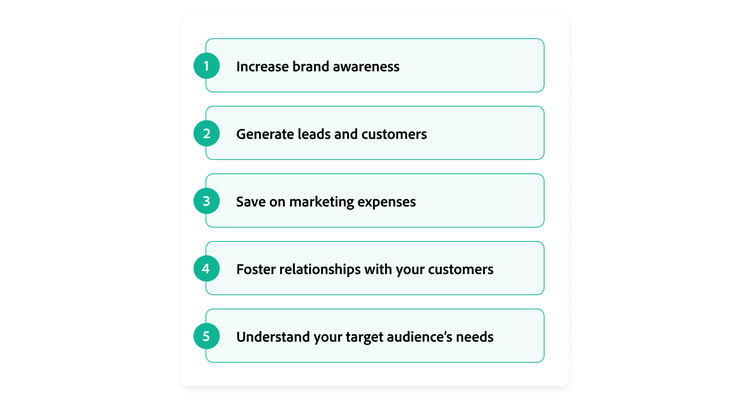
- Increase brand awareness. According to 2025 research by Kepios, social media users now number 5.24 billion. That’s a huge global audience for you to engage with. Using a tailored social strategy, you can showcase your brand on a range of platforms. This can help boost brand awareness among your target audience, but also with social media users more generally.
- Generate leads and customers. Your customers are searching for brands on social media during the purchase process, and about 27.3% of users are on social media to find products to buy in 2025. This is set to rise to 31.71% by 2029. Social media also offers more context about your products, which can increase both web traffic and sales.
- Save on marketing expenses. You don’t have to spend a dime on your social media marketing if you don’t want to. Sure, you need to invest time and resources into creating content, but organic social media content is more affordable than other marketing strategies. It’s worth noting that certain platforms have a stronger organic engagement rate than others.
- Foster relationships with your customers. Before social media, most businesses were large, faceless entities that consumers couldn’t interact with. But social media gives you the option to humanize your brand with one-on-one customer conversations at scale. Over time, you can build real connections that lead to long-term brand loyalty.
- Understand your target audience’s needs. Social media gives you a direct line to your customers. It’s a priceless opportunity to learn more about the people who support your business — and what they want to see.
What’s new in social media marketing in 2025?
- Critical growth driver. Over 60% of senior executives believe that boosting customer engagement through personalized marketing experiences will be critical to growth in 2025.
- Personalization gap. Almost 80% of consumers expect seamless experiences across digital and physical channels (including social media), but only 45% of brands currently meet this expectation. If you’re serious about reaching new customers, then personalization is a great way to go.
- Content scaling. 43% of marketing practitioners anticipate increased pressure to scale content output while keeping social media content personalized and relevant.
- Engagement and conversions: 44% of marketing practitioners expect increased demand to drive engagement and conversions on social media in 2025. This reflects the increasing pressure on marketers to demonstrate return on investment (ROI) from their social media efforts.
- AI personalization. Vanguard, a company mentioned in the report, saw a 264% increase in organic traffic and a 176% increase in quality engagement after implementing AI-driven personalization on its website and social media channels. This demonstrates the potential return on investment from effective social media personalization.
What are the best platforms for social media marketing?
Instagram :
Meta also owns Instagram, which is one of the world’s most popular visual social media platforms. On Instagram, users can post photos, Reels, Stories, and more. They can turn more heads with filters, music, and stickers too.
Since 2010, this image and video-sharing platform has incubated the influencer marketing phenomenon.
- Industry use: fashion, food, travel, beauty, art
- Audience: men and women aged 18 to 34
- Size: 2 billion monthly active users
- Best purposes: visual storytelling, influencer marketing, user-generated content.
Facebook :
Founded in 2004, Facebook is the world’s largest social media network — owned by Meta. It primarily caters to a more mature crowd of millennial, Gen X, and boomer users.
It might not be the newest social network, but many brands rely on Facebook to generate leads, increase brand awareness, or provide basic business information.
- Industry use: retail, ecommerce, real estate
- Audience: Gen X and millennials aged 35 to 44
- Size: 2.1 billion monthly active users
- Best purposes: community building, B2C, livestreams
Google :
While Google is primarily known as a search engine, it offers a wide range of tools that are essential for modern social media marketing. From advertising to content discovery, Google helps businesses connect with audiences and drive measurable results.
Key Features for SMM:
-
Google Ads: Run highly targeted paid campaigns across search, display, YouTube, and Gmail to reach potential customers.
-
YouTube Marketing: Leverage video content for brand awareness, engagement, and lead generation. YouTube, owned by Google, is the world’s second-largest search platform.
-
Google My Business: Optimize your business listing for local search, customer reviews, and visibility across Google Search and Maps.
-
Analytics & Insights: Google Analytics provides data-driven insights to track campaign performance, audience behavior, and ROI.
-
SEO Integration: Enhance your social campaigns with search-optimized content for long-term organic visibility.
Why Google SMM Works:
Google’s platforms reach billions of users globally, giving businesses the ability to target precise demographics, interests, and search intent. Whether through video, paid ads, or local search, Google ensures your brand is visible wherever your audience is actively searching or consuming content.
Best for: Brand awareness, lead generation, video marketing, local business promotion, content-driven campaigns.
YouTube :
Like TikTok, YouTube is exclusively a video-sharing social network. But unlike TikTok, YouTube allows for longer form video with a search engine-style UX.
Since 2005, this platform has given users across the globe access to explainer videos, demos, tutorials, and more. Most YouTube users are 18 to 34 years old.
- Industry use: technology, retail, DIY, fitness, CPG, food
- Audience: people aged 18 to 34
- Size: 2.5 billion monthly active users
- Best purposes: video SEO, explainer content, advertising, entertainment
LinkedIn :
First launched in 2003, LinkedIn is a business-focused platform that’s uniquely suited to the needs of B2B companies. The platform is primarily used by white-collar professionals, entrepreneurs, business owners, and job seekers. More than 57% of LinkedIn users are male, and most users are between the ages of 30 to 49.
Because LinkedIn has a professional focus, it’s more popular with B2B businesses. Use this platform to showcase your core values, mission, and company culture.
- Industry use: B2B, professional services, recruitment
- Audience: millennials and Gen X professionals, 30 to 49 years old
- Size: 875 million registered users
- Best purposes: B2B content, industry news, subject matter authority, networking
How to create a successful social media marketing strategy :
Now you’ve got clear background info, it’s time to build your strategy. Here’s how to get started.
1. Determine which social media platforms you will market on :
Resist the temptation to create a profile on every social network. At most, you likely need two or three to start out. Check your buyer personas to see which platforms your audience uses most often.
2. Set goals and KPIs to track performance :
You don’t need to track every single key performance indicator (KPI), just pick the ones that are the most important to your business development. You might include KPIs like:
- Reach. This metric measures how many unique users saw your content.
- Impressions. This is the number of times your content appeared, including repeat views.
- Engagement. This one assesses how often people interact with your posts. It’s measured by the interactions on your post divided by total impressions.
- Followers. This KPI measures how many people subscribe to your brand’s content on social media. It’s a decent indicator of audience interest.
- Profile visits. These are the number of times people visited your main profile.
- Shares. These are the number of times users reposted your content to their own social media feeds.
Choose the most important KPIs for your business goals and track them monthly. You can create a custom dashboard to track performance across all social platforms, so you don’t have to check your metrics manually.
3. Create useful and interesting content.
You don’t want your social media feed to morph into spam. Your content needs to entertain or educate your followers — otherwise, they won’t stick around.
Make sure your content ticks these boxes:
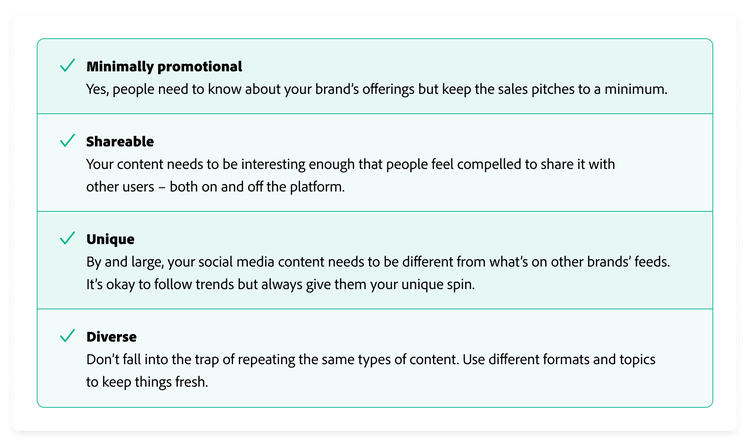
- Minimally promotional. Yes, people need to know about your brand’s offerings but keep the sales pitches to a minimum.
- Shareable. Your content needs to be interesting enough that people feel compelled to share it with other users — both on and off the platform.
- Unique. By and large, your social media content needs to be different from what’s on other brands’ feeds. It’s okay to follow trends but always give them your unique spin.
- Diverse. Don’t fall into the trap of repeating the same types of content. Use different formats and topics to keep things fresh.
4. Apply the 50-30-20 rule.
When it comes to planning your posts, a bit of balance goes a long way. The 50-30-20 rule is a great way forward. Focus 50% of your posts on value driven content — posts that provide genuine value to your audience. Then, you can use the next 30% for resharing curated content from your industry. The remaining 20% is for promotional content — so it won’t overwhelm your audience.
5. Organize your posts in a calendar.
Whether it’s a social media scheduling tool or a simple spreadsheet, a posting calendar ensures you create content on a regular, predictable schedule. Pre-plan for the week, month, quarter, or even the entire year at once. This helps you take advantage of seasonal content and reduce the burden of daily content creation.
6. Assess and update your strategy regularly.
No strategy is set in stone. Things change, and your social media marketing strategy should flex to fit current conditions.
Don’t be afraid to let go of content or approaches that aren’t working. Check your analytics regularly to see if you need to make any adjustments. Your metrics will tell you which posts were more successful, when your audience is online, and other essential data.
How to keep your social media marketing strategy running smoothly :
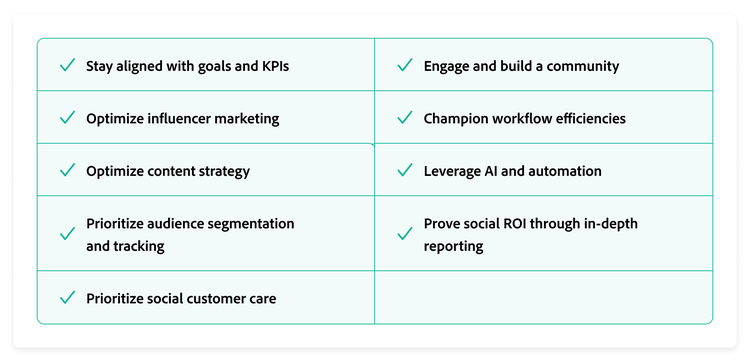
Sustaining a successful social media presence requires ongoing effort and adaptation. This section outlines key strategies for maintaining an effective social media marketing strategy, drawing upon best practices and leveraging data-driven insights.
Stay aligned with goals and KPIs :
Define clear success metrics (such as brand awareness, engagement, lead generation, or conversions) and align your KPIs (followers, reach, click-through rate, or engagement rate) with these objectives. Regularly monitor performance against these KPIs to ensure your strategy remains on track.
Optimize influencer marketing :
Integrate an influencer marketing platform to streamline workflows, track campaign performance, and measure ROI. Prioritize influencers who align with your brand values and resonate with your target audience. Focus on creators with proven experience and authenticity.
Leverage AI and automation :
AI streamlines workflows, freeing up time for strategic tasks. Use AI for content recommendations, creation, automated posting, and sentiment analysis. Implement chatbots for instant customer interaction and improved support. AI-powered analytics helps track engagement, conversions, and customer journeys, enabling real-time campaign optimization.
Prove social ROI through in-depth reporting :
Demonstrate the value of your social media efforts by providing regular, data-driven reports. Use customizable reporting tools to highlight key metrics aligned with business priorities. Showcase how social media drives leads and contributes to the overall marketing strategy.
Prioritize audience segmentation and tracking :
Use platform-specific data and AI-powered tools to segment audiences based on demographics, interests, behaviors, and sentiment. Employ advanced targeting features (custom and lookalike audiences) to maximize ad reach and engagement.
Optimize content strategy :
Create a balanced mix of content formats (videos, infographics, carousels, and user-generated content) to maintain high engagement. Monitor mentions and tags to identify positive customer interactions and share them to build trust. Use AI tools to overcome creative blocks and generate content variations tailored to your brand voice and audience preferences. Avoid chasing every trend. Instead, focus on consistent, high-quality content aligned with your brand persona.
Champion workflow efficiencies :
Streamline your team’s workflows using intuitive social media management solutions. Automate repetitive tasks, centralize communication, and leverage reporting tools to save time and improve efficiency.
Prioritize social customer care :
Provide quick, personalized customer care through tools like saved replies and case management. Humanize your brand by responding promptly and authentically to customer inquiries.
Engage and build a community :
Respond promptly to comments and messages, using tools to prioritize inquiries. Collaborate with brand advocates to share authentic content. Encourage user participation through polls, Q&As, and challenges.
Analyze and iterate :
Consistently analyze and track your efforts, testing ad creatives, captions, and posting times. Use data to refine your approach, identify top-performing content, and establish benchmarks for future campaigns.
Examples of social media marketing strategies that work :
- Barbie : In 2023, Warner Brothers’ marketing teams went all in on Instagram and TikTok to make sure that the Barbie movie was at the forefront of everyone’s minds. User-generated content — featuring fans recreating iconic Barbie looks and sharing their movie experiences — went viral, significantly boosting brand awareness and generating considerable pre-release buzz. This translated to strong box office results and a massive return on the marketing investment.
- Wicked : The Wicked movie campaign used a multi-platform approach, combining teaser trailers and behind-the-scenes content on YouTube with interactive polls and Q&As on Instagram and X. This strategy effectively built anticipation and engaged a broad audience, leading to significant pre-release excitement and ultimately strong box office performance.
- Spotify Wrapped : Spotify Wrapped is an annual campaign that leverages user data to create personalized “year in music” summaries. This super shareable content generates massive organic engagement across social media, boosting brand awareness and reinforcing Spotify’s position as a leading music streaming service. The campaign’s success is a testament to the power of personalized, data-driven marketing.
Getting started with social media marketing :
A well-defined social media marketing strategy can drive engagement, boost brand awareness and drive business growth.
As we’ve discussed :
- Taking a data-driven approach, informed by audience insights and performance metrics, is essential for maximizing ROI.
- Understanding your target audience, selecting the right platforms, creating engaging content, and leveraging the power of influencer marketing are all key components of a successful strategy.
- Regularly monitoring and analyzing your efforts, adapting to platform changes, and using AI-powered tools can further enhance your results.