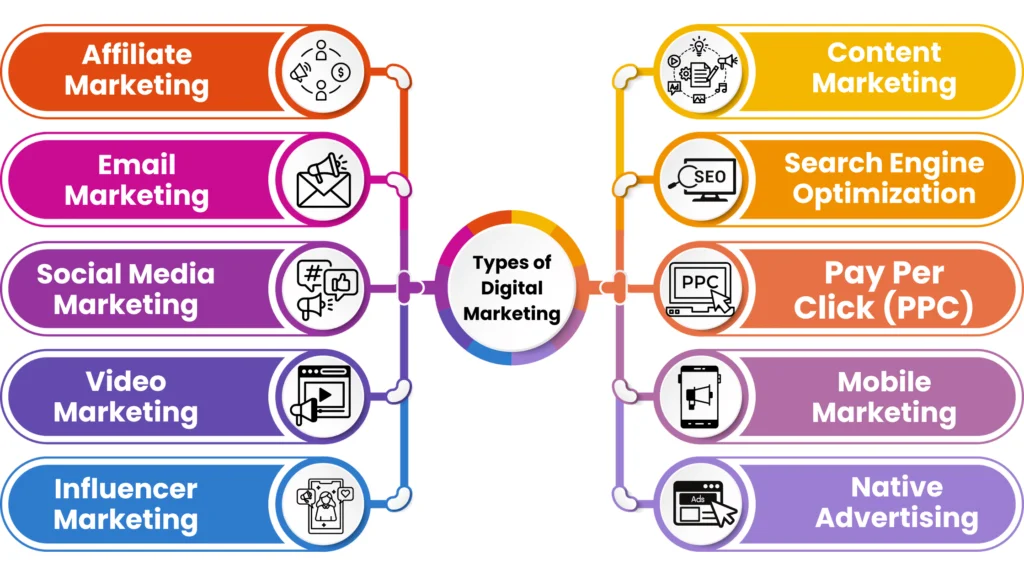
There are many forms of digital marketing, from web pages to social media platforms and content creation. Some key types include:
Owned media.

1. Content Marketing :
Content marketing aims to educate and share value to readers instead of promoting a product or service. It isn’t outwardly promotional but establishes your business as a thought leader and a trustworthy source of information.
Businesses use content marketing to attract leads and convert them into loyal customers. Content marketing forms include:
- Blog posts
- eBooks
- Newsletters
- Guides
- Infographics
- Audio content, like podcasts
- Video content, like YouTube Shorts
Content marketing is not only affordable, but it’s also effective. In 2022, 80% of marketers thought their content marketing strategy was very successful. It’s no wonder why the content marketing industry is projected to be worth $107 billion by 2026.
Read more about Content Marketing.
2. Email Marketing :
Email marketing is a form of direct marketing where you reach out to your customers through strategic email messages. Email marketing can take many forms, but the more common types of emails businesses send include blog subscriptions, newsletters, welcome emails, and post-purchase follow-ups.
Best practices to get more out of your email marketing campaigns:
- Include the recipient’s name in the email body and subject line, at a minimum.
- Always make the intention of the email clear with a single call to action.
- Include an unsubscribe link in all of your email signatures.
- Integrate transactional and promotional emails.
3. Search Engine Optimization (SEO) :
SEO is the process of optimizing the content, technical setup, and reach of your website so your pages appear at the top of a search engine results page (SERP) for a specific set of keyword terms. Some important terms include:
- On-page SEO. With the right list of target keywords, you can optimize your web copy to answer your audience’s most important questions.
- Off-page SEO. The ways you can garner external attention to your website. This generally focuses on gathering quality backlinks to your site.
- Technical SEO. Monitors the back end of your website and the coding of each page. Considers page speed, image compression, and metadata.
Paid media.

4. Search Engine Marketing (SEM) :
SEM revolves around paid ads that display in the SERPs. Paid search typically refers to the sponsored result on the top or side of a SERP. These ads appear when users enter a certain search term. As the advertiser, you pay every time someone clicks on your ad. The two most popular SEM platforms are Google Ads and Microsoft Ads.
SEM works because 68% of online experiences start with organic and paid searches. By promoting your brand at the source of most online experiences, you can attract more interested leads to your site.
5. Affiliate Marketing :
Affiliate marketing recruits affiliates to promote a business’s product or service to their followers. When a customer makes a purchase through that affiliate, the affiliate earns either a percentage commission or a flat-rate finder’s fee.
With affiliate marketing, you’re promoting your business through someone with an established platform and connections to your target audience. The affiliate’s audience already trusts them, and if the affiliate recommends your brand, their audience is more likely to trust your business by association.
Affiliate marketing comes in different forms. For example, some affiliates will do reviews or unboxing videos for products. Other affiliates might use your products and will link to your company in their content.
6. Pay Per Click (PPC) :
With pay-per-click advertising you pay every time someone clicks on your ad. Google Ads is the most popular PPC platform for search engines, but Microsoft Ads, Meta Ads, YouTube Ads, and Amazon Ads are also valuable platforms for PPC.
Best practices to get more out of your paid ads:
- Improve ad quality by optimizing your Quality Score in Google Ads.
- Create ads that are relevant to your target audience’s pain points.
- Optimize the quality of your landing pages.
Ad prices vary a lot, and without a solid plan and experience, PPC can become very expensive. Make sure you understand the nuances of bidding on your PPC platform of choice.
Earned media.

Read more about Pay-Per-Click (PPC)
7. Social Media Marketing (SMM) :
Social media marketing promotes your business organically through various social networks. It is effective for digital marketing because it gives businesses the power to chat with their most engaged followers one –on one. Facebook, Instagram, YouTube, TikTok, and X (formerly Twitter) are the most popular social platforms.
Here are some best practices to increase your reach on social media:
- Know your audience, including their favorite social media platforms.
- Produce engaging, high-quality content.
- Respond to comments and questions within 24 hours, if possible.
- Stick to a consistent posting schedule.
The more your audience is inspired to engage with your content, the more likely they are to share it.
8. Influencer Marketing :
With influencer marketing, brands promote their products or services through popular content creators. Influencer marketing is similar to affiliate marketing in that you can capitalize on an established, captive audience that inherently trusts the influencer.
But influencer marketing doesn’t involve profit sharing. Instead, you typically pay the influencer a flat fee in exchange for promoting your product.
With an average engagement rate of nearly 16% on platforms like TikTok, it’s no wonder why more brands are embracing influencer marketing.
Tips to make the most of influencer marketing:
- Partner with influencers with familiarity to your industry and a good reputation.
- Establish a clear and precise written agreement for compensation.
- Provide the influencer with clear guidelines on language, tone, and logistics.
9. Native Advertising :
Native advertising creates ads that mimic the look and feel of a platform. The goal is to make the ads not seem like advertising, but as just another piece of content.
Shoppers assume paid ads are biased and ignore them, so native ads are advertisers’ answer to declining conversion rates. For example, a business with a native ad might design it to look like a typical Facebook post.
Native ads are tricky because they mimic the look and feel of organic content, but advertisers still need to be transparent about the fact that these are ads. Native ads usually include qualifiers like “sponsored” or “promoted” so it’s clear that it’s paid content.
Other marketing.

10. Marketing Automation :
Marketing automation streamlines marketing tasks by automating them. This type of digital marketing uses artificial intelligence (AI) and machine learning (ML) to power digital marketing campaigns. Marketing automation handles mundane and repetitive tasks so marketers can focus on high-level strategy and creativity instead.
Typical marketing automation tasks include:
- Streamlining tasks and workflows.
- Measuring results.
- Calculating campaign ROI.
With automation, you can analyze larger amounts of customer data in little time. Use these insights to create better, more personalized campaigns.
11. Mobile Marketing :
Mobile marketing is tailored to mobile devices and mobile users. It engages your target audience on mobile devices, like smartphones and tablets, as well as wearables like smartwatches.
With mobile marketing, businesses often reach out to subscribers via SMS messaging. Since most of us have our phones on us 24/7 no matter where we are, mobile marketing makes it possible for businesses to send timely messages. Like email marketing, mobile marketing gives you a one-on-one connection with your customers.
12. Video Marketing :
In video marketing you promote your business through either long-form or short-form video. YouTube is the most obvious place to do video marketing, but social media platforms like TikTok and Instagram are also great for promoting your brand with videos.
If you want to go all-in on YouTube, remember that it isn’t primarily a social network — it’s a search engine.
If you have a smartphone, you have the capability to make quality videos for your company’s website, social media, email campaigns, and paid ads.
Read more about Video Marketing.